A Better Way to Work in Excel with AI Today
Jun 23, 2026
Across various modern organizations, Artificial Intelligence now handles a massive percentage of the operational tasks that most professionals still execute manually in Microsoft Excel. Despite this rapid technological shift, one fundamental principle has not changed: the distinct barrier that separates fast, unverified output from reliable, high-integrity financial work.
An ordinary Excel task still tends to follow a highly familiar, exhausting pattern. A raw dataset arrives, and it requires extensive attention before any meaningful analysis can begin. Dates appear in completely different, fragmented formats. Quantities are erroneously recorded as a mix of both text and numbers. Duplicate entries distort the baseline integrity of the data, and columns fail to align consistently. Before anything useful can be extracted, the data must be rigorously cleaned.
That preparation process consumes an immense amount of corporate time. It involves repeating the exact same mechanical steps across thousands of rows and columns, identifying structural inconsistencies, fixing errors manually, and then checking the results all over again. By the time the dataset is finally ready for analysis, much of the analyst's intellectual energy has already been spent on mere preparation rather than strategic interpretation.
It was this exact working reality that Daniel Saheed addressed in his recent high-impact session, “The Lazy Analyst’s Guide: Using AI to Automate the Excel Tasks You Hate.” His starting point was not what Artificial Intelligence can achieve in theory, but precisely where corporate professionals lose the most time in daily practice.
Why Routine Execution Mimics a Skill Problem
What makes this pattern easy to misinterpret is where the frustration shows up. The inefficiency happens inside Excel, so the instinctive response is to assume that the limitation must be technical. If the work feels slow, then the conclusion is usually that more formulas are needed, better shortcuts, or greater familiarity with the tool itself.
During the session, Daniel challenged that legacy thinking directly. The core issue is not that the financial work is too difficult; it is simply that much of it is entirely repetitive.
Tasks such as cleaning data, removing duplicates, standardising regional formats, and repairing broken formulas follow the exact same algorithmic pattern every time. They are necessary steps, but they do not require sustained, strategic analytical thinking. Over time, they consume immense human effort without increasing the actual value of the output.
Once that paradigm shifts, the problem begins to look entirely different. It is no longer about improving at Excel alone, but about fundamentally changing how data work is approached.
The Operational Shift of Automated Workflows
The introduction of Artificial Intelligence into the Excel ecosystem begins to shift that operational approach in a highly practical way. Instead of executing each tedious step manually, the workflow can now be described and delegated. Data cleaning that once required multiple manual passes can now be completed in moments. Formatting inconsistencies can be resolved across massive datasets instantly, and complex formula errors can be identified and corrected with far less human effort.
As Daniel Saheed noted during the live session:
“English is becoming the new programming language.”
What he was pointing to is not merely the velocity of execution, but a permanent change in how professional work is expressed. The limiting factor is no longer how many obscure Excel syntax codes you have memorized, but how clearly you can define what needs to be done. The corporate workflow moves away from mechanical repetition and transitions entirely toward strategic instruction. This shift, however, introduces a different kind of professional challenge.
Where the Real Corporate Risk Begins
As execution becomes effortless, it is highly tempting for organizations to assume that the underlying skill requirement for analysts has reduced as well. If the automated tool can handle the entire process, then the need to understand the underlying mechanics may appear less pressing to an untrained professional.
In the words of Daniel, “It can get you to an output fast, but you still need to know whether that output makes sense.”
That statement reframes the entire conversation surrounding corporate automation. Artificial Intelligence can generate results at an extraordinary pace, but it does not guarantee that those results are accurate. Cleaned datasets can still contain deep structural anomalies. Generated formulas can break catastrophically when integrated into a broader corporate model, and reports can look visually flawless without reflecting financial reality.
What changes, therefore, is not the importance of human understanding, but the severe consequences of lacking it.
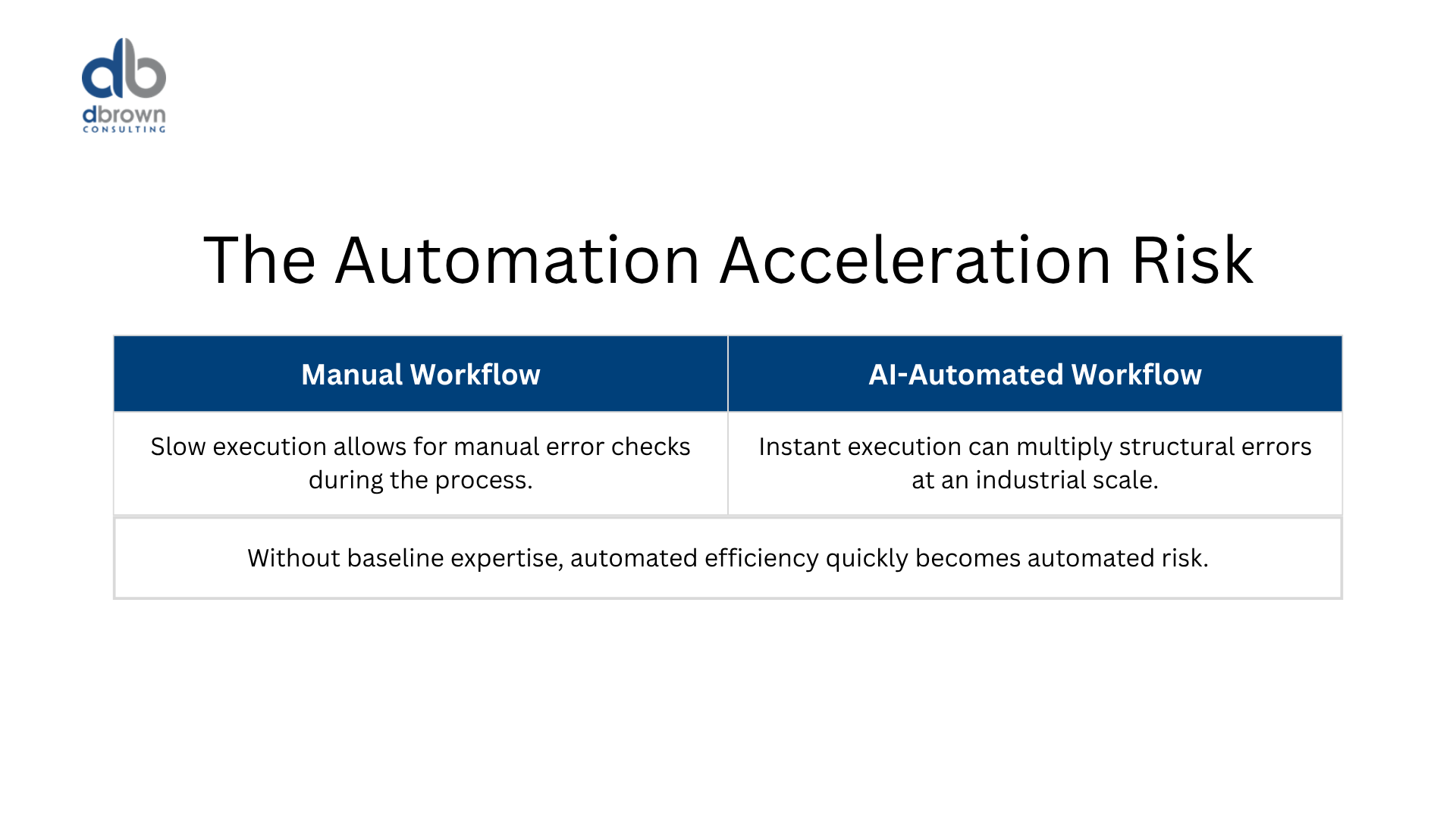
Errors can now be produced faster and at an industrial scale. What looks highly efficient on the surface can quickly become deeply misleading to stakeholders.
This reality shifts the exact role of the modern analyst. According to Daniel, your responsibility moves completely away from doing everything manually and transitions toward structuring the work, guiding the automated process, and validating the final outcome. The corporate emphasis has permanently changed from execution to interpretation.
This has become the defining line in the modern marketplace: some professionals will use Artificial Intelligence to accelerate what they already thoroughly understand, while others will depend on it blindly without being able to evaluate whether the data produced is correct or flawed.
What Actually Matters in the Modern Market
The professionals who benefit the most from this technological shift are not necessarily those who use AI tools more frequently, but those who already deeply understand how their financial models function from first principles.
They recognize precisely how inputs flow into outputs. They can trace subtle inconsistencies and identify the exact point where assumptions break down. When Artificial Intelligence produces a rapid financial result, they do not accept it immediately. They review it, stress-test the logic, and adjust the parameters where necessary. That exact combination of execution speed and foundational understanding is what constitutes the real competitive advantage.
Across corporate teams, this paradigm is already highly visible. Execution is faster, stakeholder expectations are higher, and delivery timelines are tighter than ever before. At the same time, absolute accuracy remains non-negotiable. Financial models continue to shape capital allocation and corporate strategy, and small algorithmic errors still carry massive organizational consequences.
Why True Competence Requires More Than Tools
As the nature of data work evolves, the importance of your educational foundation becomes significantly more pronounced. Financial modeling, for instance, is not about producing complex spreadsheets for their own sake. It is about structuring complex corporate problems, translating abstract assumptions into rigid financial logic, and ensuring that outputs behave consistently under volatile market conditions. Without that underlying structure, faster tools only increase the speed at which catastrophic mistakes are made.
The ultimate advantage, as Saheed made clear throughout his masterclass, lies in understanding how the financial system works beneath the surface. Technological tools will continue to improve rapidly, but the absolute responsibility for interpreting and verifying their output remains entirely with the professional using them.
The Financial Modeling Academy (FMA) scholarship is engineered entirely around this rigorous progression. The curriculum focuses on helping corporate participants move beyond merely executing basic tasks toward understanding and controlling the overarching systems behind them. It combines advanced model building, deep interpretation, and strict validation into a single, comprehensive framework that perfectly reflects how elite work is executed in practice.
With that foundation established, tools like Artificial Intelligence do not replace your skill; they enhance your leverage. You are no longer working through the mechanical process; you are actively directing it.
Advance Your Corporate Capability
The Financial Modeling Academy provides the structured, elite pathway required to transition from a manual spreadsheet builder to a globally accredited strategic advisor. The academy thoroughly prepares you for global certification through the prestigious Financial Modeling Institute (FMI), Canada.
Review our available scholarship pathways and secure your seat for the upcoming professional intake.
Explore the FMA Scholarship Routes and Apply for the Next Cohort Here