Career Pathways: What Financial Modeling Careers Actually Look Like
Aug 28, 2026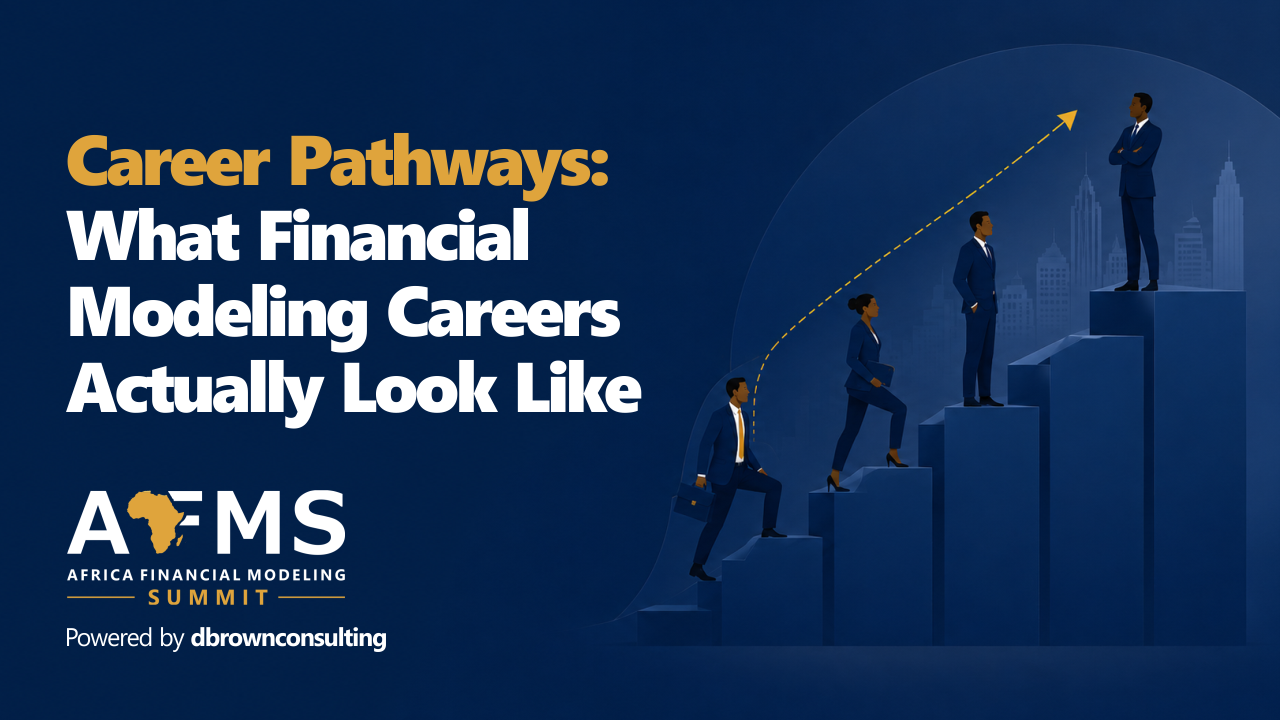
When Enitan Adelakun graduated with a degree in Accounting, she believed she understood what a career in finance would look like. She could begin in audit, pursue a professional accounting qualification, and eventually move into financial reporting or management accounting. These were credible career paths, but they were also the routes most frequently discussed during her undergraduate years.
Her National Youth Service Corps (NYSC) posting placed her in the finance department of a growing consumer business. Most days involved updating schedules, supporting reconciliations, preparing reports, and comparing actual expenditure with approved budgets. Then, during a planning meeting, a senior manager asked what would happen to the company’s cash position if sales declined, and a proposed expansion was delayed by six months.
Enitan knew where to find the historical figures. She could explain what the business had earned and spent. Whereas, what her manager wanted was for her to connect the assumptions, model their combined financial effect, and show management the range of possible outcomes.
This sent her down the rabbit hole of the skill called financial modeling and marked her introduction to a side of finance which her degree had barely explored. Accounting taught her to explain what had happened but financial modeling could help the business examine what might happen next.
Is Financial Modeling a Career or a Skill?
Financial modeling can be both a specialised career and a capability used within a broader finance role. Some professionals work as Financial Modelers, Model Audit Specialists, or Project Finance Modelers, with primary responsibility for building, reviewing, or maintaining models. Many others use financial modeling without carrying it in their job titles.
An FP&A analyst builds forecasts and tests business scenarios. An investment analyst values companies and estimates potential returns. A project finance professional assesses how an infrastructure project could be funded and whether it can repay its debt.
This is why searching only for “financial modeler” vacancies can create a misleading picture of the market. The better approach is to examine which decisions different roles support and where financial modeling is required to make those decisions.
What Financial Modeling Career Opportunities Exist in Africa?
- Financial Planning, Commercial Finance and Strategy
Financial planning and analysis, commonly called FP&A, is one of the clearest routes for professionals with modeling skills. FP&A teams prepare budgets, update forecasts, analyse differences between planned and actual performance, identify business drivers, and present insights to management. An analyst may model the effects of changing prices, opening a branch, launching a product, hiring more employees, or losing an important customer.
Related opportunities exist in commercial finance, strategic finance, treasury, performance management, corporate planning, and finance business partnering. These roles suit professionals who want to understand how businesses operate and help management make decisions about future performance.
- Investment, Valuation and Transaction Careers
Financial models are also central to investment banking, private equity, venture capital, asset management, equity research, corporate development, transaction advisory, and mergers and acquisitions. Professionals in these fields use models to answer questions such as: What is a business worth? Is an acquisition financially attractive? How should a transaction be funded? What returns could an investor earn, and which assumptions could weaken the investment case?
These careers require more than advanced Excel skills. You must understand financial statements, valuation, capital structures, market conditions, and the commercial reasoning behind an investment. They must also explain and defend their conclusions clearly.
- Project, Infrastructure and Development Finance
Africa’s demand for investment in energy, transportation, telecommunications, housing, agriculture, and water creates another important route for financial modelers. Professionals in project and infrastructure finance forecast long-term cash flows, model debt repayment, examine construction timelines, test pricing assumptions, and assess whether a proposed project can satisfy lenders and investors.
Opportunities include project finance analyst, infrastructure finance specialist, renewable energy analyst, real estate financial analyst, and development finance professional. Because these models often incorporate commercial contracts, financing agreements, and technical plans, practitioners must understand the real project behind the spreadsheet.
- Consulting, Risk and Independent Work
Financial modeling also supports careers in consulting, restructuring, financial due diligence, credit analysis, risk management, and model auditing. Professionals may help organisations evaluate acquisitions, raise capital, examine business plans, test downside scenarios, or review important investment models. Treasury and risk professionals use models to assess liquidity, debt obligations, foreign-exchange exposure, funding options, and the possible effect of changes in interest rates or operating costs. These capabilities are especially important in African markets where currency volatility and capital constraints can quickly alter a financial plan.
Financial modeling is not limited to employment within established organisations. Entrepreneurs use models to estimate capital needs, test pricing, forecast cash flow, evaluate expansion, and communicate with investors or lenders. With experience, practitioners can also pursue freelance modeling, outsourced FP&A, fundraising support, startup advisory, business-plan development, model reviews, or professional training. Remote work has widened the market, although international opportunities still require practical experience, commercial understanding, strong communication, and evidence of previous work.
What Skills and Qualifications Do Financial Modelers Need?
Financial modelers need accounting and finance knowledge, spreadsheet proficiency, clear model structure, scenario and sensitivity analysis, and the ability to test their work for errors.
Technical capability alone is insufficient. Employers also value professionals who understand the business behind the numbers, challenge unrealistic assumptions, interpret model outputs, and communicate recommendations to decision-makers.
Structured training can help professionals move from theory to practical application. Through the Financial Modeling Academy, participants practise building models and applying financial concepts to business cases.
The Advanced Financial Modeler accreditation subsequently provides a way to demonstrate practical competence under examination conditions. However, neither training nor accreditation guarantees employment. They develop and validate capability, but industry knowledge, professional judgment, communication, and experience remain essential.
Where Can a Career in Financial Modeling Lead?
A career may begin in an analyst role and progress into commercial finance, investment analysis, project finance, consulting, corporate development, entrepreneurship, or finance leadership.
The route is rarely linear. An accountant may transition into FP&A. An FP&A analyst may move into strategic finance or finance business partnering. A valuation professional may enter investment banking, corporate development, or private equity.
What connects these careers is not a single job title. It is the ability to translate assumptions into financial consequences and help organisations make better decisions.
This breadth is reflected in the FMA community, whose alumni apply financial modeling skills across banking, corporate finance, consulting, investment management, entrepreneurship, and other sectors.
On 23 October 2026, members of that community will gather in Lagos for the exclusive FMA Alumni Awards & Cocktail Night, held ahead of the Africa Financial Modeling Summit 2026. The evening will recognise alumni achievements while creating opportunities for graduates, industry leaders, summit speakers, and invited guests to connect.
Perhaps someone with a journey like Enitan’s will hear their name called. Not because one qualification created their career, but because they developed financial modeling competence and applied it to decisions that matter.
Some professionals build models full-time. Many others use modeling within roles that influence business performance, investments, transactions, infrastructure development, and strategy.
The strongest financial modeling careers are not built around Excel alone. They are built around the importance of the decisions a professional becomes capable of supporting.
To follow the AFMS 2026 Conversation join the AFMS 2026 waitlist for priority updates on registration, confirmed speakers, programme details, and summit participation. See you there! Join the AFMS 2026 Waitlist
Editor’s note: Enitan is a fictional composite created to illustrate career decisions commonly faced by early-career finance professionals. Her journey reflects the different ways financial modeling capability can support career development. The roles and market examples discussed in this article are based on publicly available career information and current job listings.