How to Turn Financial Modeling Skills Into Career Opportunities
Sep 08, 2026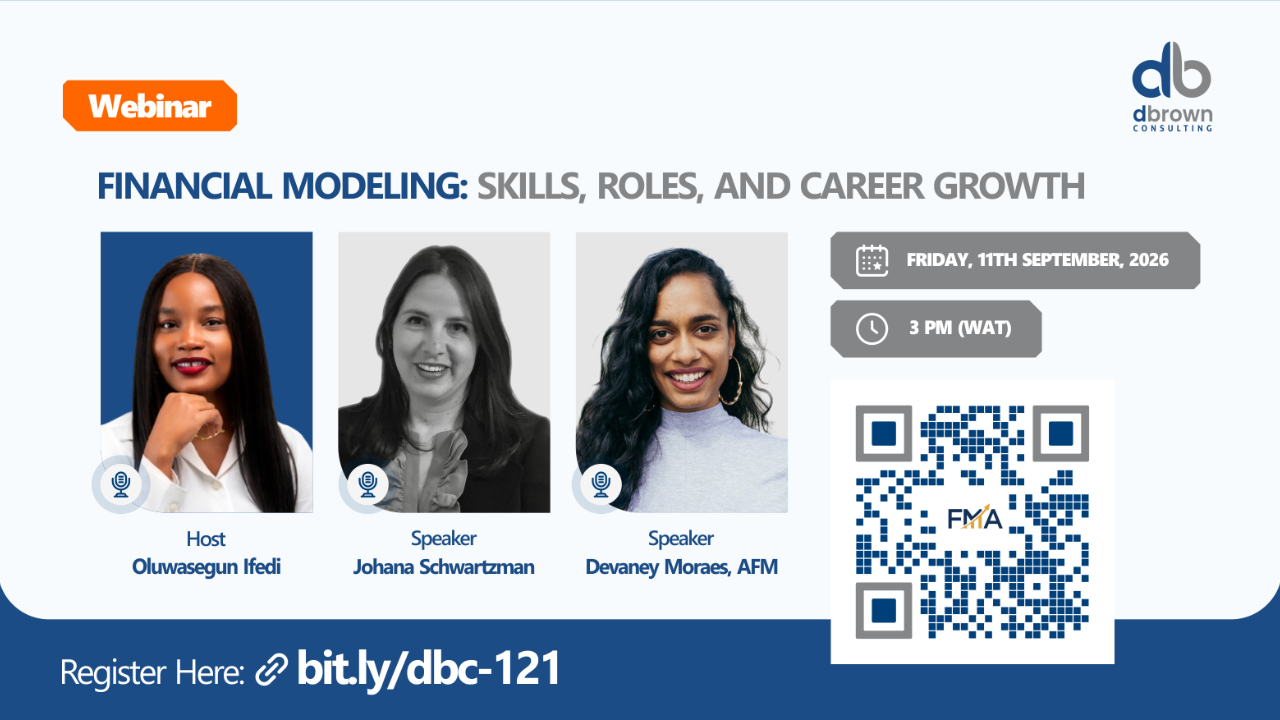
Earning a financial modeling credential can strengthen your CV, but it will not automatically place you in front of employers, clients, or decision-makers. Opportunities emerge when people can see your capability, understand its relevance, and trust you to apply it to real business problems.
The relationship between financial modeling competence and career growth was explored during a recent dbrownconsulting webinar, Financial Modeling: Skills, Roles and Career Growth. The session featured Johanna Schwartzman, Chief Revenue Officer at the Financial Modeling Institute, and Devaney Moraes, Senior Manager of Exam Operations and Candidate Experience.
Drawing on their work with financial modeling professionals worldwide, both speakers shared practical insights on validating technical capability, building professional visibility, and converting financial modeling skills into meaningful career opportunities.
Financial modeling can create professional credibility because it combines technical finance knowledge with forecasting, commercial judgment, and decision support. Developing the skill, however, is only one part of the equation. You must also validate your competence, demonstrate its practical application, and position yourself where employers, clients, and industry peers can recognise its value.
Technical Skill Is Only the Starting Point
Financial modeling demands more than spreadsheet proficiency. A capable modeler must understand finance and accounting, structure assumptions clearly, connect financial statements correctly, identify errors, and translate results into useful recommendations.
A reliable model should also make sense to someone other than its creator. Excessive tabs, buried hard-coded values, unnecessarily complex formulas, and unclear assumptions make a model difficult to review and risky to use.
Strong financial modelers can:
- Build forecasts from historical information and business assumptions.
- Connect the income statement, balance sheet, and cash flow statement.
- Trace errors to their source and correct them.
- Explain the reasoning behind material calculations.
- Present model outputs as a coherent business story.
- Defend their assumptions when stakeholders ask difficult questions.
These capabilities support budgeting, valuation, credit analysis, investment decisions, operational planning, and strategic leadership.
Validated Capability Gives Employers a Clearer Signal
Anyone can list financial modeling as a skill. Independent validation gives employers stronger evidence that the claim has been tested.
The Financial Modeling Institute’s Advanced Financial Modeler accreditation is a practical assessment rather than a course-completion certificate. Candidates receive historical financial information and a business case, then build a three-statement model from scratch during a four-hour proctored examination. The assessment tests structure, accuracy, presentation, time management, and the ability to translate business information into a working forecast.
Research conducted by the Financial Modeling Institute in 2024 also offers insight into the value alumni associate with the accreditation:
- 87% said the AFM accreditation had influenced their careers.
- 84% reported greater confidence in financial modeling.
- 78% said the programme had strengthened their technical skills.
These are self-reported alumni outcomes, not guaranteed results for every candidate. Still, they suggest that the preparation process can strengthen practical competence and confidence, while the designation provides an independently validated signal to employers and clients. Readers can review the 2024 AFM alumni research.
Your Accreditation Will Not Market Itself
A credential proves that you have met a defined standard. It does not automatically explain what problems you can solve or why an employer should choose you.
Converting validation into visibility requires deliberate action:
- Update your professional identity. Add the designation to your CV, LinkedIn profile, email signature, and professional biography.
- Share informed commentary. Publish useful observations about forecasting, business performance, investment decisions, and financial modeling.
- Add your perspective when reposting content. A few original sentences can demonstrate expertise more effectively than sharing a link without comment.
- Participate in professional communities. Engage with content and conversations from dbrownconsulting, the Financial Modeling Institute, and credible finance networks.
- Describe outcomes rather than software. Explain how your model clarified risk, tested an investment, improved planning, or strengthened a decision.
- Keep practising. Your current ability must continue to justify the designation attached to your name.
A Portfolio Shows How You Think
An accreditation confirms competence under assessment conditions. A portfolio demonstrates how you apply that competence.
Using fictional, public, or properly anonymised information, your portfolio could include:
- A three-statement financial model
- A scenario and sensitivity analysis
- A valuation or investment case
- The business question behind each model
- Key assumptions and design choices
- A short recommendation based on the results
The objective is not to overwhelm recruiters with spreadsheets. It is to show that you can structure an ambiguous problem, build a defensible analysis, and communicate what the numbers mean.
Career Changers Should Build on Existing Domain Knowledge
Moving into finance does not require discarding your previous experience. A professional transitioning from healthcare, technology, engineering, or another sector can combine industry knowledge with financial modeling capability.
Someone who understands healthcare operations, for example, may be well positioned to model hospital expansion, pharmaceutical investments, or health-sector projects. Financial modeling becomes the technical layer that converts existing domain expertise into financial analysis and decision support.
The Financial Modeling Academy, delivered through the partnership between dbrownconsulting and the Financial Modeling Institute, provides structured training in practical model-building and preparation for the AFM assessment. Participants learn to build three-statement models from scratch, work through business cases, and develop the confidence to explain and defend their work.
Career momentum comes from combining capability, validation, visibility, and continued application. Learn the skill, prove it, demonstrate how you use it, and remain visible in the communities where opportunities are created.