The Little Finance Everybody Needs
May 29, 2026
The Little Finance Every Professional Needs: Key Insights from Dr. Ola Brown
There comes a definitive point in many professional careers where sheer effort is no longer the problem. You show up consistently. You deliver on your assignments. You understand your functional role well enough to work seamlessly without supervision. Yet, somehow, your career progression begins to stall.
Strategic conversations move ahead without your input. Major business decisions are made elsewhere. Individuals who are not necessarily more capable than you suddenly seem to carry far more weight when it matters most in the boardroom.
What changes at that advanced stage is not the volume of work being executed, but the fundamental nature of the work itself. Routine execution becomes expected, and mature business judgment becomes necessary. At that executive level, almost all corporate decisions are tied, directly or indirectly, to capital.
This professional tension formed the centre of our most recent flagship masterclass, “The Little Finance Everybody Needs,” where David Brown (Managing Partner at dbrownconsulting) hosted Dr. Ola Brown (Founder of HealthCap Africa and a leading voice in African venture capital). Rather than explaining corporate finance in abstract or overly academic terms, the session focused explicitly on why highly intelligent professionals hit this exact ceiling in their careers and how they can navigate beyond it.
The Silent Gap Most Professionals Do Not Notice Early Enough
Long before that career ceiling becomes obvious, a quiet, limiting pattern has already taken shape. For many corporate professionals, the distance from financial literacy begins with something remarkably small. It frequently stems from a poor early experience with mathematics in school, or simply an internalized belief that numbers are inherently difficult to manage.
Over time, this discomfort grows into a consistent pattern of professional avoidance. Mathematics is set aside, then statistics, then core accounting, until finance itself feels like a distant, unnecessary language. The decision to disengage seems completely harmless at first because it does not immediately affect daily performance. It becomes a major constraint only when the strategic expectations of your role begin to elevate.
During the live session, David Brown made this reality clear by explaining that true leadership growth eventually becomes entirely intertwined with financial understanding. In his words, professionals often reach a stagnant stage where they cannot progress further because they are fundamentally unable to interpret what the numbers within the business are saying. This manifests as an inability to understand why a company can appear highly profitable on paper while actively struggling with liquidity, or a failure to recognize what specific financial signals imply for future corporate strategy. At that point, the knowledge gap shifts from being a minor theoretical lack to an absolute operational constraint.
The Profit Paradox: A Simple Idea That Changes Everything
One of the most effective ways the discussion illustrated this analytical gap was through a simple, counterintuitive business truth: A corporate enterprise can be highly profitable on paper and still go completely bankrupt.
This is not an abstract concept; it reflects a widespread misunderstanding in the corporate world. As David Brown explained, many professionals falsely assume that net profit and cash flow are identical, when in reality, they serve entirely different functions within an organization. A company may record massive revenue and project a healthy profit on its income statement, but if customers delay their payments while vendor expenses must be settled immediately, the business will quickly find itself operating without the liquid cash it needs to survive.
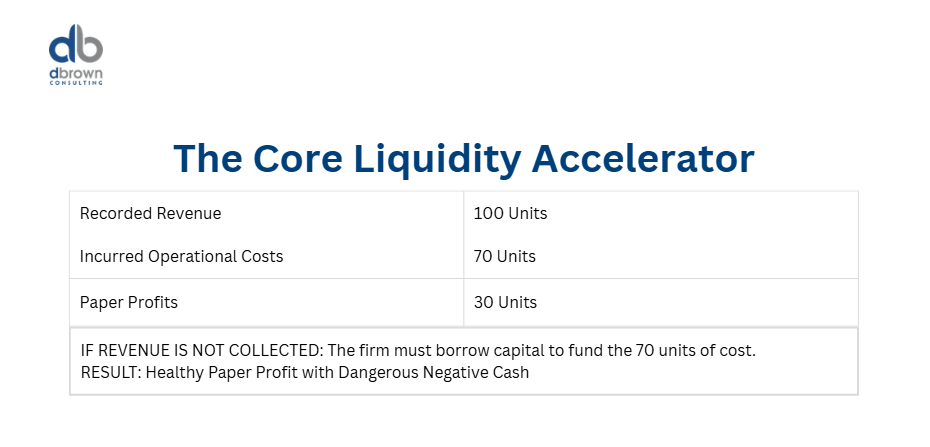
In such a situation, the company remains technically profitable on paper while operating with a highly dangerous negative cash flow. If this structural gap is not managed properly by leadership, it ultimately leads to corporate failure. Understanding this distinction entirely shifts how performance is interpreted and how organizational risk is managed.
Reframing Finance as an Active Framework
Once that core clarity is established, finance ceases to look like an intimidating technical barrier. It transforms into a practical way of thinking about executive decisions and their long-term consequences.
This distinction was reinforced during the session through a sharp comparison between accounting and finance:
- Accounting: Focuses strictly on the historical recording of what has already occurred in the past.
- Finance: Focuses entirely on utilizing that historical information to decide what strategic actions should happen next.
Dr. Ola Brown added another layer to this principle by grounding the idea in everyday experience. She explained that finance ultimately determines the velocity at which money moves in and out of our lives, influencing how people earn, spend, protect, and plan for the future. Consequently, it shapes not just corporate entities but individual lifestyle choices as well. Seen from that perspective, finance is not a specialized skill reserved for a select few; it is a practical framework that governs success across all areas of life.
While these ideas can be studied theoretically, they often become meaningful only when they are experienced directly through practical application. Dr. Ola Brown’s own professional trajectory reflects this truth clearly. Before entering the venture capital space, she was a medical student who needed to supplement her income. This reality led her to start a small retail business where she purchased discounted products and resold them at a margin.
Through that early entrepreneurial venture, she was forced to engage with profit margins, product pricing, and cash flow in a very real, high-stakes way. She described how this immediate exposure forced her to understand exactly how revenue is generated, how operational costs affect outcomes, and how cash projections are absolutely necessary when there are immediate financial obligations to meet. Her subsequent transition into running large businesses and eventually founding a venture capital firm built directly upon that practical foundation. The progression did not begin with abstract theory; it began with real-world decisions that carried immediate consequences.
Three Behavioral Patterns That Stagnate Progress
Even when individuals are exposed to financial concepts, certain behavioral mistakes remain exceptionally common across the industry. Dr. Ola Brown highlighted three specific patterns that consistently hold intelligent professionals back from achieving true scale:
- The Lifestyle Inflation Trap: As personal or business income increases, spending frequently increases at the exact same rate. Over time, this creates an exhausting cycle where individuals appear to be progressing financially on the surface without actually building any true stability or wealth retention.
- The Absence of Operational Structure: At higher institutional levels, financial resources are managed with rigid systems and intentional, long-term planning. In contrast, many professionals manage money without any consistent framework, making critical allocation decisions based on immediate, short-term needs rather than compounding outcomes.
- Misunderstanding the Nature of Wealth: Income represents what is earned in the present, while true wealth reflects what is built, invested, and sustained over time. Without recognizing this fundamental difference, immense professional effort fails to translate into long-term advancement.
Taken together, these patterns do not reflect a lack of intelligence; they are simply the direct result of failing to engage deeply with how capital behaves over time.
Breaking Through the Career Limitation
Over time, these personal financial gaps extend directly into your professional career. Executive roles require far more than basic task execution; they demand deep analytical interpretation. There is an immediate organizational expectation to evaluate complex trade-offs, manage risk, and contribute to strategic decisions that influence the long-term direction of the firm. These responsibilities are fundamentally financial in nature, even when they are not explicitly labeled as such.
Without financial clarity, it becomes exceptionally difficult to engage at this leadership tier. Conversely, once you develop this literacy, the way you approach your daily work changes entirely. Systematic patterns become easier to recognize, market risks become visible earlier, and boardroom decisions become significantly more deliberate. That difference, though subtle at first, entirely shapes your long-term career trajectory.
However, recognizing the importance of finance is only the first step in the process. Applying it consistently under pressure is what creates true corporate value. This is where structured analytical disciplines such as financial modeling become highly relevant. Financial modeling provides the exact architecture required to translate abstract business assumptions into clear, dynamic frameworks. It allows an advisor to test multiple scenarios, stress-test variables, and evaluate financial outcomes before major decisions are finalized. In essence, it moves finance from an abstract concept into an actionable tool for real-world strategy.
Take Control of Your Professional Trajectory
For ambitious professionals who recognize this critical gap in their current skill set, the next logical step is to build that capability in a structured, world-class environment.
The Financial Modeling Academy (FMA) scholarship is engineered specifically to support that transition. The curriculum focuses heavily on developing both the technical spreadsheet mastery and the sharp analytical skills required to understand complex financial systems deeply and apply them with absolute confidence in professional environments. Furthermore, it provides the structured pathway required to attain global professional certification through the prestigious Financial Modeling Institute (FMI), Canada.
The “little finance” most people need is not complex. It is simply the ability to understand how money behaves, how decisions affect long-term outcomes, and how to interpret what the numbers in any corporate situation are actually saying. Those who develop this understanding early gain an unassailable competitive advantage in the marketplace. Those who delay it eventually encounter its absence.
Review our structured scholarship pathways and secure your seat for the upcoming professional cohort. Explore the FMA Scholarship Routes and Apply for the Academy Here