Why Financial Modeling Matters in Africa Right Now
Jul 17, 2026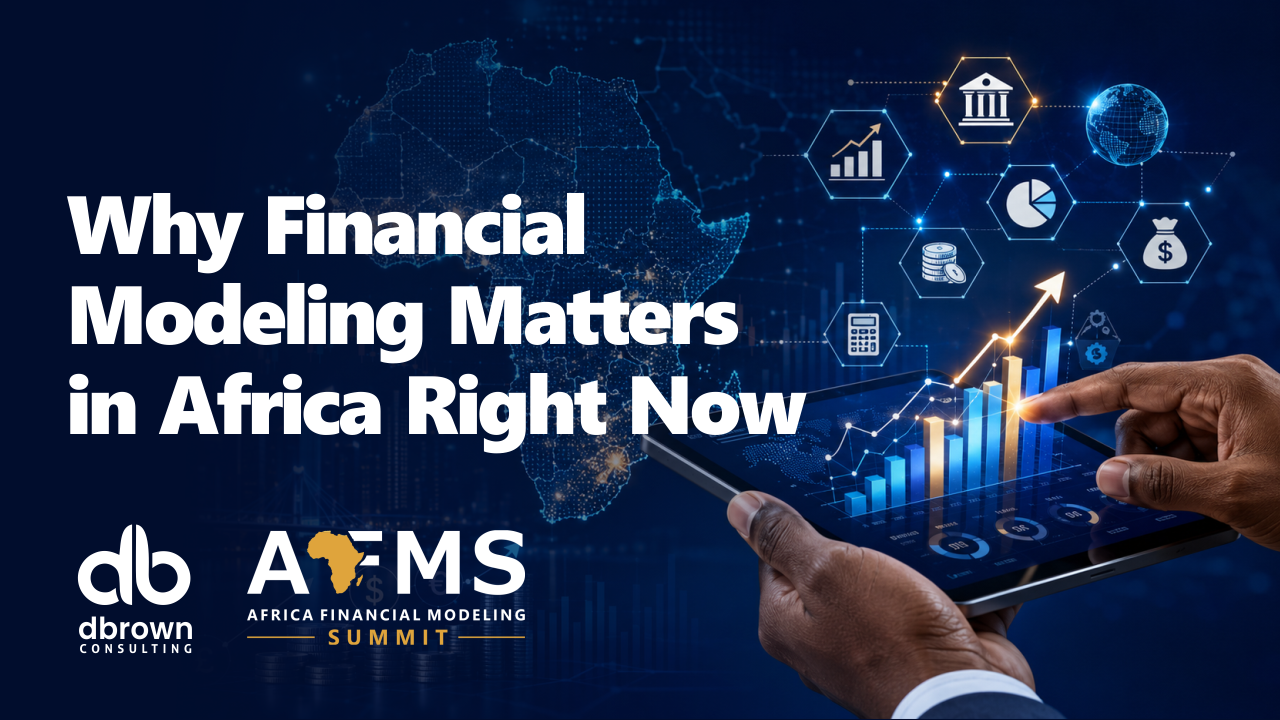
Financial modeling in Africa is gaining new urgency. Across the continent, finance professionals are working in an environment shaped by currency movements, capital constraints, infrastructure needs, investor scrutiny, and changing business models.
In this context, financial modeling is no longer just a technical spreadsheet skill. It is becoming a core capability for decision-making, risk evaluation, capital allocation, and strategic planning.
To understand why this matters now, it helps to look briefly at how financial modeling evolved globally.
A Brief History of Financial Modeling
Before modern spreadsheet software, financial planning was largely manual. Finance teams worked with ledgers, calculators, accounting schedules, and static tables. The major shift came with the rise of electronic spreadsheets.
VisiCalc, launched in 1979 for the Apple II, is widely recognized as the first spreadsheet program for personal computers and helped establish the personal computer as a serious business tool. Its major breakthrough was that changing one input could automatically recalculate dependent outputs, making “what-if” analysis far more practical for business users.
That capability changed finance work. Over time, spreadsheet-based analysis became central to budgeting, forecasting, valuation, investment appraisal, project finance, scenario planning, and corporate decision-making. Financial modeling moved beyond arithmetic. It became a structured way to connect assumptions, data, logic, and business judgment.
From Spreadsheet Skill to Professional Discipline
Today, financial modeling is increasingly treated as a professional discipline. Authors and educators such as Simon Benninga, whose textbook Financial Modeling became a staple for finance students and practitioners worldwide, helped establish structured modeling as a core component of modern finance education.
The Financial Modeling Institute further describes financial modeling as integral to decision-making across banking, private equity, accounting, asset management, insurance, business development, venture capital, and other finance-related fields. The institute was founded in 2017 to assess financial modeling acumen and test whether professionals can structure, build, and draw insight from models under practical conditions.
This matters because the quality of a model affects the quality of decisions. Veteran modeling practitioners have long emphasized that a model's value lies not in its complexity but in its ability to communicate assumptions clearly, test scenarios rigorously, and support better decision-making.
A model that is unclear, inflexible, or poorly documented can weaken management judgment, investment decisions, and organizational planning. A well-built model does the opposite: it brings structure, transparency, and discipline to financial decision-making.
Why Financial Modeling Matters in Africa Now
Financial modeling is not new in Africa. Banks, investment firms, development finance institutions, infrastructure teams, corporate finance departments, and advisory firms have used models for years. What is changing is the level of strategic importance attached to the skill.
Africa’s finance landscape is becoming more complex. The World Bank’s Africa’s Pulse notes that Sub-Saharan Africa continues to operate amid global uncertainty and restricted fiscal space, even as growth projections improve.
For finance teams, this means static forecasts and isolated spreadsheets are no longer sufficient. Organizations need models that can test scenarios, evaluate downside risks, support funding decisions, and explain the financial impact of strategic choices.
The Growing Demand for Modeling Capability
The demand for financial modeling skills is increasingly visible across African markets. Training providers now emphasize integrated three-statement models, valuation, forecasting, sensitivity analysis, scenario modeling, budgeting, investment appraisal, and strategic decision support.
Course descriptions from African training institutions highlight the need for models that improve forecasting accuracy, strengthen investment decisions, support budgeting, and improve financial visibility.
This points to a broader market shift. Finance professionals are no longer being asked only to report what happened. They are increasingly expected to explain what could happen, why it could happen, and what the organization should do in response.
What This Means for Finance Professionals
For CFOs, financial modeling is a governance issue. A model used for capital allocation, fundraising, expansion planning, or strategic transformation must be reliable enough to support serious decisions. CFOs do not need to build every model themselves, but they need the literacy to question assumptions, identify weak logic, challenge outputs, and understand the risks embedded in projections.
For analysts and modelers, technical Excel skills are no longer enough. The value lies in building models that communicate business logic, test assumptions, and help decision-makers understand possible outcomes. A good model should not only calculate numbers. It should clarify the financial consequences of strategic choices.
For students and early-career finance professionals, financial modeling builds discipline in thinking through assumptions, understanding business drivers, linking financial statements, and communicating through numbers. These capabilities are relevant across corporate finance, investment banking, consulting, private equity, FP&A, infrastructure finance, entrepreneurship, and advisory work.
This Conversation Needs a Platform
The future of finance in Africa will require stronger analytical capability. Organizations will need finance teams that can move faster, test more scenarios, and make decisions with better visibility. Financial modeling sits at the center of that shift.
This is why the conversation should not remain isolated within individual organizations or training rooms. As financial modeling becomes more important to capital allocation, forecasting, investment decisions, and governance, finance professionals need spaces where they can examine what good practice looks like in real markets and learn from practitioners applying these methods.
That is the role AFMS is designed to play. The Africa Financial Modeling Summit 2026 brings together finance leaders, analysts, modelers, students, and practitioners to examine how financial modeling is evolving across Africa, what capabilities professionals need to build, and how organizations can strengthen the quality of financial decision-making.
If financial modeling in Africa is becoming central to serious finance work, then the time to engage with the discipline is now. Anticipate AFMS2026.